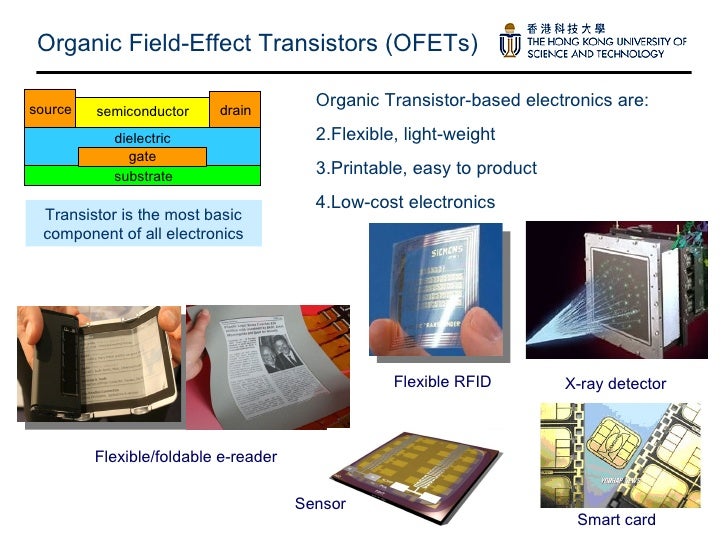
Organic Electronics Emerging Concepts and Technologies by Circuit Diagram Flexible electronic devices in biomedicine, environmental monitoring, and brain-like computing have garnered significant attention. Among these, organic electrochemical transistors (OECTs) have been spotlighted in flexible sensors and neuromorphic circuits for their low power consumption, high signal amplification, excellent biocompatibility, chemical stability, stretchability, and flexibility Organic Electronics is a new field of electronics in which the structures that are used are based on organic materials: dielectric, conductive or OP-AMP circuit design External in DEMO2_V1, integrated in DEMO2_V2 External load (due to test equipment) External biasing . OP-AMP layout

7.2.1.3 Organic electronics. For dozens of years, discussion has been ongoing on an unseen industrial techno-economic semiconductor - organic electronics.Organic electronics could be a technological revolution for the production of more ecological and cheaper semiconductors, equipped with more properties, notably for energy recovery, display (which has begun in televisions and flexible

Organic Electronics - an overview Circuit Diagram
the improvements of organic electronics. In the first part, I explore device engineering for organic thin film transistors (OTFTs). An OTFT circuit design methodology is proposed to enable accurate analysis and verification in the design stage. Various topologies of digital circuits such as complimentary and unipolar OTFT

Organic electronic devices include organic thin film transistors (OTFTs), organic light emitting diodes (OLEDs), sensors, memories and more. In this paper we will review research developments in materials, technology and circuit design for electronics based on organic thin film transistors and we shall try to find out which upcoming research is

Organic electronics Circuit Diagram
Various topologies of digital circuits such as complimentary and unipolar OTFT circuits based on this design methodology are demonstrated. The third part focuses on application engineering, specifically on the implementation of disposable and flexible organic electronic sensors.